Part One
That Thursday afternoon, as Marissa turned onto Ridge Hollow Lane, her most pressing worry was whether the avocados she’d bought were ripe enough.
The office had let everyone go early after the company server crashed, so she’d swung by the market on the way home. Thursdays meant guacamole—Caleb’s small ritual. Such a mundane, ordinary thought for a wife that later, when she replayed it, the memory would sting with a strange, hollow ache.
She’d picked up avocados, limes, cilantro, and the overpriced tortilla chips Caleb always complained were too salty, yet somehow vanished before dinner ever started. The grocery bag pulled at her fingers as she trudged up the driveway, the twisted paper handle cutting a red line into her palm.
From the front, the house looked perfectly fine.
The sprinklers ticked across the lawn. Upstairs, the curtains hung half-open. Caleb’s brand-new truck gleamed in the driveway like a trophy he’d insisted he earned after a grueling quarter at work. Marissa had balked at the price, but Caleb had kissed her forehead and told her she worried beautifully.
That was one of his specialties—dressing condescension in the velvet of affection.
Ridge Hollow was the sort of neighborhood where tall fences were meant to suggest privacy, though everyone knew everyone’s business. New cars, barking dogs, and whose guest visited too often—nothing went unnoticed.
Vanessa from number 218 had been one of those familiar faces.
Initially, Marissa had genuinely liked her. Vanessa remembered birthdays, showed up with banana bread when Marissa was under the weather, watered her basil, and dropped by with easy smiles and flimsy excuses. She borrowed sugar despite throwing flawless dinner parties. She knew the gate code because Marissa had given it to her freely.
That was the detail Marissa would obsess over later.
Not the pool.
Not the discarded clothes.
The gate code.
Betrayal doesn’t always kick the door in. Sometimes you hand it a key and call it friendship.
When Marissa pushed open the kitchen door, the backyard hit her with chlorine, warm stone, and the earthy scent of basil near the grill. Sunlight blazed against the glass doors, blinding her for a second.
Then she heard the water.
A wet slap against tile.
Then another.
Wrong.
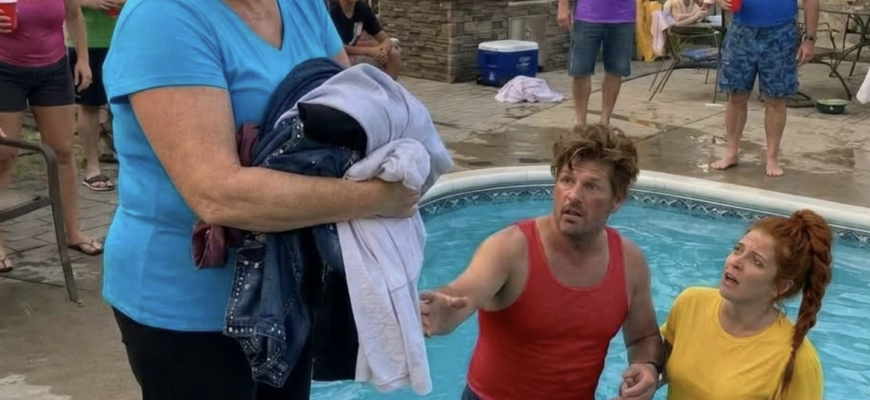
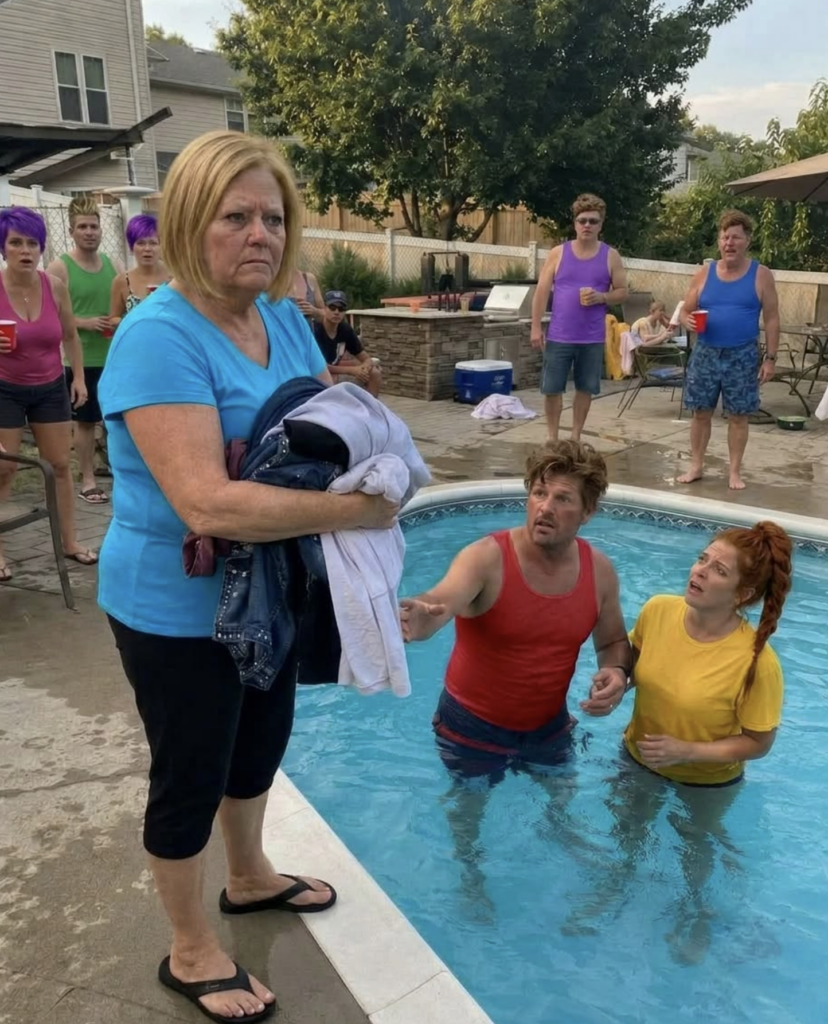
Caleb was in the pool.
Vanessa was in his arms.
Her black bikini top lay draped over Marissa’s patio chair. Caleb’s linen trousers were folded neatly beside it—tidy enough to prove no one had been in a hurry until that door swung open.
Caleb spotted her first.
“Marissa,” he said, as if she were the interruption.
Vanessa sank lower into the water, only her shoulders and mouth visible. Her red lipstick was smeared at the corner—the exact shade Marissa had noticed on a coffee mug in her own kitchen the week before.
That memory crashed back with brutal clarity.
Vanessa had stood at Marissa’s island, cradling that mug, asking if Caleb was still working late so often.
Marissa had answered honestly.
Because she had trusted the woman asking.
Then Marissa’s gaze dropped to the wet footprints.
They didn’t lead from the side gate.
They didn’t lead from the guest path.
They led from her kitchen door.
The grocery bag sagged in her hand. One avocado rolled out and tapped softly against the outdoor sink.
The sound was small.
Final.
“Don’t make a scene,” Caleb said.
That was the real end of the marriage. Not the sight of him with Vanessa. Not the clothes. It ended when Caleb looked at his wife, standing there with groceries, and his first thought was how loud she might get.
Marissa didn’t scream.
She didn’t cry.
She walked to the lounge chairs and calmly gathered their things. Caleb’s shirt. His belt. His keys. Vanessa’s sundress. Her sandals. Her phone, buzzing with missed calls from Mark—her husband.
“Please,” Vanessa whispered. “We can explain.”
Marissa nodded at the wet footprints. “You already have.”
Caleb moved toward the pool’s edge. “Don’t be dramatic.”
There it was again—the role he’d already written for her. If she raised her voice, she was unstable. If she wept, she was hysterical. If she demanded answers, she was humiliating him.
Men like Caleb don’t just betray you. They grade your reaction afterward.
Marissa’s hand tightened around the damp clothes. Then her eyes shifted to the red emergency button beside the kitchen entrance.
The security system—the one Caleb had mocked for months.
Marissa had installed it after a string of break-ins nearby. Caleb had called her paranoid at dinner parties, joking that she was turning their home into a bank vault.
But that system now linked the gate camera, pool camera, doorbell, patrol dispatch, and the Ridge Hollow community alert.
Caleb knew that.
His face changed.
“Marissa. No.”
She pressed the button.
The siren ripped through the backyard—sharp, brutal, impossible to ignore. Dogs barked down the street. Curtains twitched. A garage door rolled up two houses away. Mrs. Palmer peered over her fence in muddy gardening gloves. Two teenagers stopped their bikes at the curb. A delivery driver froze beside his van.
For a few seconds, the whole neighborhood held its breath.
Caleb shouted, “Turn it off!”
Marissa stood by the alarm panel, their clothes draped over her arm.
“Why?” she asked. “You brought this five feet from my kitchen.”
Vanessa covered her face.
The water could hide skin.
It couldn’t hide the truth.
—
## Part Two
Marissa’s phone buzzed.
Security company: emergency confirmed, patrol notified.
Then the Ridge Hollow community app lit up.
*Backyard alarm at 214 Ridge Hollow Lane.*
That alert mattered more than Caleb understood. It created a timestamp. It created witnesses. It created a public record of the exact minute the lie stopped belonging only to the person who’d been hurt.
At 5:42 that afternoon, Caleb’s secret became an event.
Marissa reached into Caleb’s pants pocket and retrieved the key fob to his new truck.
Caleb’s mouth opened.
She held it up between two fingers. “This,” she said, “is the last thing of yours going into my pool.”
Then she dropped it into the deep end.
The fob vanished beneath the blue water.
For the first time, Caleb had nothing to say.
Vanessa made for the side gate, but before she could move, a car door slammed out front.
Her face crumpled. “Mark,” she whispered.
Marissa didn’t move.
A black SUV had stopped at the curb. Mark, Vanessa’s husband, stepped out and walked toward the house slowly. He wasn’t running. Somehow, that made it worse. A running man still hopes to stop the truth before it lands. Mark walked like someone who already knew he was too late.
Then Marissa’s phone buzzed again.
Doorbell camera: motion clip saved, front entry, 5:39 p.m.
She looked at the thumbnail—Caleb and Vanessa at the kitchen door. Caleb’s hand rested low on Vanessa’s back as he guided her inside.
Three minutes before Marissa came home.
Not through the side gate. Not through the patio. Through the kitchen—the same kitchen where Vanessa had borrowed sugar, the same kitchen where Marissa made Caleb’s morning coffee.
Marissa opened the clip.
There was no audio, but the image said everything. Caleb glanced around, punched in the code. Vanessa laughed. He kissed her quickly before the door opened.
Careless.
Familiar.
Something inside Marissa went quiet—not numb, but organized.
Vanessa caught her expression. “What?”
Marissa turned the screen toward Caleb.
His face showed calculation before guilt.
That hurt more.
“Marissa,” he said, lowering his voice beneath the siren, “don’t show him that.”
The doorbell rang through the backyard speaker—polite and absurd against the alarm.
Marissa answered through the camera. “Mark.”
His pale face filled the screen.
“Before you open this door,” he said, his voice controlled, “tell me one thing. How long has my wife been using your kitchen door?”
Vanessa made a small broken sound from the pool.
Marissa didn’t answer immediately. She scrolled through the camera history.
There were more motion clips from past Tuesdays. Some showed Vanessa arriving with an empty measuring cup. Some showed Caleb opening the door while Marissa was gone. Some showed Vanessa leaving with sunglasses on and her hair different from when she arrived.
The camera hadn’t known what it was saving. Machines don’t understand betrayal. They simply keep time.
Marissa opened the front door.
Mark stood there in a dark polo, one hand braced against the frame.
“I’m sorry,” Marissa said.
It was the first useless thing she’d said all afternoon.
Mark walked through the house without asking. Marissa followed him to the patio.
When he saw the pool, Vanessa covered her mouth. “Mark,” she said.
He didn’t answer.
He looked at Caleb. Then at the clothes over Marissa’s arm. Then at the patio chair, the phone, the wet footprints, and the glowing security panel.
The scene explained itself.
Caleb tried to speak. “Mark, listen—”
Mark raised one hand.
Caleb stopped.
That single gesture did what Marissa’s pain hadn’t been allowed to do—it silenced him.
The patrol officer arrived six minutes after the alarm confirmation. By then, more neighbors had gathered outside. Mrs. Palmer watched through the fence slats. The teenagers had rolled their bikes farther down the curb but hadn’t left.
The officer asked if there was an intruder.
Marissa looked at Caleb and Vanessa, still trapped in the pool. “Not the kind you can arrest today,” she said.
Because the emergency alarm had dispatched patrol, the officer took a report. He recorded the timestamp. He recorded that Marissa was the homeowner. He recorded that two people had been found in the backyard pool without proper clothing nearby. He recorded that one had entered through the kitchen shortly before the alarm.
Caleb hated that part. He kept trying to soften the story—privacy, misunderstanding, marital issues—anything vague enough to blur the truth.
But the officer kept writing.
Paper has a way of offending people who depend on charm.
Vanessa finally climbed out, wrapped in a towel from the storage bench. Caleb had to wait until Marissa tossed him his clothes one piece at a time.
Nobody laughed.
That almost made it worse.
The neighborhood had seen enough to talk for years, but no one treated it as entertainment. Humiliation could be deserved and still ugly. Marissa didn’t need to enjoy it. She only needed to stop protecting him from it.
When the siren finally stopped, the silence felt enormous.
Caleb turned to her. “Can we talk inside?”
Marissa almost laughed. *Inside.* After everything, he still thought the kitchen was neutral ground.
“No,” she said.
“Marissa, please.”
She looked at the man who had called her *careful* when he meant boring, *paranoid* when he meant inconvenient, and *dramatic* when he meant dangerous to his image.
“I’m done discussing my marriage in rooms where you bring other women.”
Mark drove Vanessa home in silence.
Caleb’s truck remained in the driveway because the key fob was somewhere at the bottom of the pool.
That detail traveled through Ridge Hollow faster than the alarm.
By 7:10, Marissa changed the gate code.
By 7:32, she downloaded every saved security clip.
By 8:04, she emailed them to herself, her sister, and a divorce attorney whose name she’d once saved for a friend.
She barely slept.
Caleb slept in the guest room after discovering she’d locked the bedroom door.
From across the hallway, he texted her: *We need to handle this carefully.*
Marissa stared at the word. *Carefully.* That was what he called secrecy after getting caught.
—
## Part Three
The next morning, Marissa called a pool service. The technician arrived before noon and fished Caleb’s key fob from the deep end with a long net.
It no longer worked.
Caleb stood on the patio, watching water drip from the dead plastic shell.
Marissa signed the invoice and kept a copy.
Petty, maybe. Also documentation.
Over the next week, Caleb tried every apology in the book. Shock. Shame. Stress. Blaming Vanessa. Blaming the pool alarm. He even said Marissa had made everything worse—as if the siren had ruined their marriage and he’d only been standing nearby.
Marissa listened once.
Only once.
Then she played the 5:39 doorbell clip.
Caleb went quiet when he saw his hand on Vanessa’s back.
He went even quieter when Marissa played the next clip.
A Tuesday.
Then another.
Then another.
Not all proof explodes. Some proof repeats until denial runs out of air.
Three days later, Mark texted Marissa: *Thank you for not letting them make us both stupid.*
She sat at the kitchen island and cried when she read it.
Not because of Mark. Because he understood.
The cheating was one wound. The staging was another. Caleb and Vanessa had used ordinary neighborly life as camouflage, then expected the people they hurt to feel ashamed for noticing.
The divorce wasn’t clean. Divorces rarely are.
Caleb wanted the house listed immediately. Marissa refused. Her attorney used the patrol report, the alarm timestamp, the camera clips, and Caleb’s own messages to build a timeline.
The security system Caleb had mocked became one of the strongest pieces of evidence.
The backyard pool became less of a luxury item and more of a witness stand.
There were mediation sessions downtown in a conference room that smelled of burnt coffee. Caleb sat across from her in a suit too formal for the moment, while his lawyer tried to make betrayal sound like a misunderstanding.
Marissa sat through three sessions before she stopped feeling the need to explain herself.
Dates did more work than outrage. Timestamps did more work than tears.
At one point, Caleb argued that the security footage violated his privacy. Marissa’s attorney dismantled that so calmly that even the retired judge mediating the case almost smiled.
Marissa didn’t get everything. Nobody does.
But she got the house through settlement.
Caleb got his dead key fob back in a plastic bag because his attorney insisted personal property be returned.
Marissa mailed it with tracking.
She allowed herself one small smile.
Vanessa and Mark sold their house before the end of the season. Mrs. Palmer left a basil plant on Marissa’s porch with a note: *“For the grill.”*
Marissa held it in the doorway for a long time.
People surprised her after that. Some were nosy. Some were kind. Some pretended they hadn’t watched from their windows, which was kinder than admitting they had.
A woman two streets over left a card in Marissa’s mailbox with only four words: *Good for you.*
No signature. No explanation needed.
Marissa kept that card in a kitchen drawer. On harder days, she took it out and read it again.
In the weeks that followed, she noticed small things she’d ignored for years—the way evening light crossed the kitchen, the different smell of basil after rain, the sound of the refrigerator at night, a sound Caleb had always complained about.
She realized she’d spent years adjusting her life to his comfort.
Without him, the silence didn’t feel empty. It felt like room to breathe.
In October, her sister flew in for a weekend and helped repaint the guest room a soft gray—a color Caleb would have called depressing. They sat on the patio late into the night, drinking cheap wine and eating cheese neither of them usually bought.
Her sister admitted she’d never liked Caleb.
Marissa laughed until she almost cried.
How many quiet opinions had been standing politely outside her marriage the whole time?
She told her sister about the avocados—how that detail haunted her more than the pool, the bikini, or the truck.
Her sister said maybe the avocados mattered because they proved who Marissa had been when she walked up the driveway: an ordinary woman thinking about dinner. Not a fool. Not a victim. Just someone who had trusted the wrong door.
Months later, Marissa swam in the pool alone for the first time. The water was cold. The tile made the same soft slapping sound. The basil had grown thick over its pot.
She floated under the afternoon light and looked toward the kitchen door.
For a moment, she remembered herself standing there with grocery bags cutting into her fingers, watching two people wait for her to become small.
She hadn’t become small.
She’d pressed one button.
By the next spring, the house finally felt like hers.
She replaced the lounge chairs—not as a dramatic statement, but because the old ones were worn out. She painted the kitchen a warm yellow that Caleb would have called bad for resale value. That had been one of his favorite phrases—as if they were always preparing the house for strangers instead of living in it themselves.
In June, she hosted a small dinner with her sister and two friends from work.
No one brought banana bread with an agenda.
No one knew the gate code except the people Marissa chose carefully.
People sometimes asked whether she regretted making the whole neighborhood look.
Marissa always gave the same answer.
*Caleb brought it five feet from my kitchen. All I did was refuse to keep it quiet.*