My daughter-in-law forced me out of the house over $1,800,000 on the very day of my son’s funeral, telling me, “Go back to the Carpathians and die, old woman.” What she didn’t know was that beneath a rotten floorboard in the old hut, Oleksandr had left behind an envelope sealed by a notary.
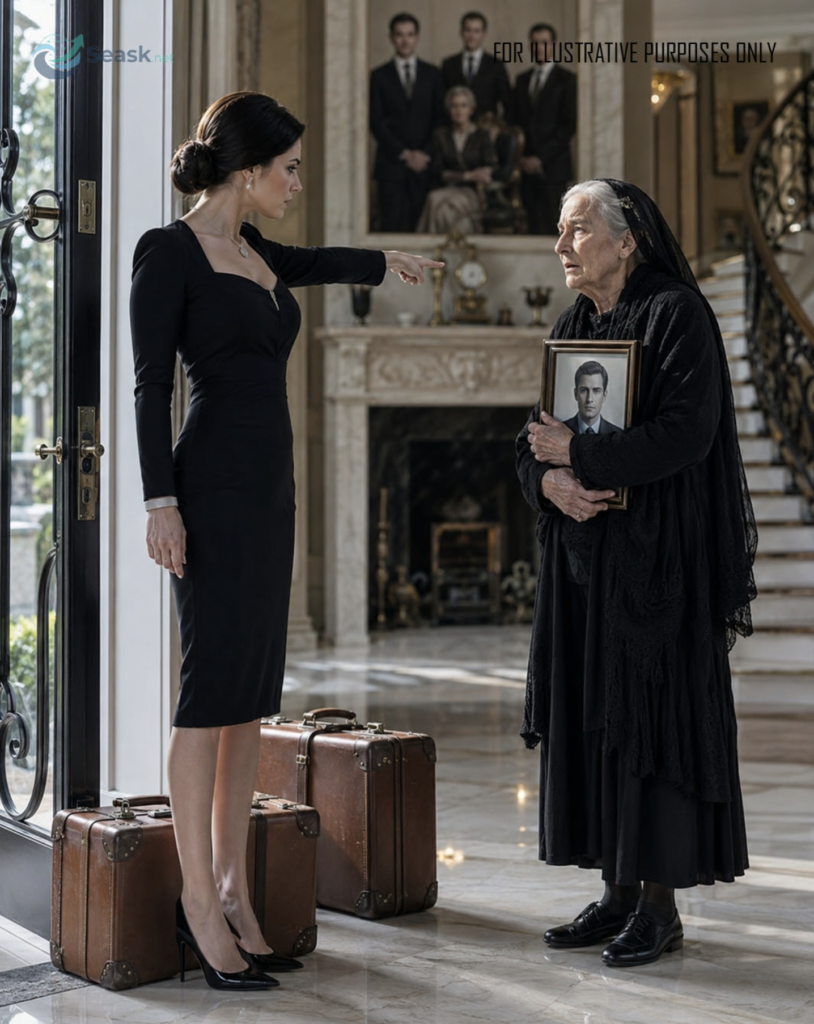
She shoved my suitcase toward the door without a word.
It was 6:42 p.m. when we returned from the cemetery. Damp clay still clung to my heels, my black scarf stuck to my neck, and the bitter taste of cheap funeral coffee lingered in my mouth. The entrance hall of the Pechersk house smelled of wax, white lilies, and cold marble.
My son Oleksandr had been buried less than two hours earlier.
And Kseniia, his wife, had already placed my two worn suitcases by the door.
She stood in a black dress, perfectly composed, makeup untouched. On her wrist was the watch Oleksandr had given her for their anniversary—the same expensive one he once joked I would scold him for buying.
“Mrs. Nadiia, the driver will take you to the house in Yaremche,” she said softly.
I looked around the house—at the oak railings I had polished every Friday, the cracked vase I had carefully repaired, and the photograph of Oleksandr above the fireplace. In it, he stood smiling in a blue shirt, his hands resting on my shoulders.
“I want to take the photo,” I said.
Kseniia stepped in front of it.
“All of this is mine now. Even what’s in that frame.”
I had lived in that house for ten years. I baked for his business partners, ironed linen tablecloths, and planted roses under the terrace. To guests, I was “Oleksandr’s mother.” Behind closed doors, she called me an old servant.
I stayed silent—for my son.
At 7:08 p.m., she motioned toward my coat.
“Go back to the Carpathians and die, old woman.”
Not shouted. Almost polite. That made it worse.
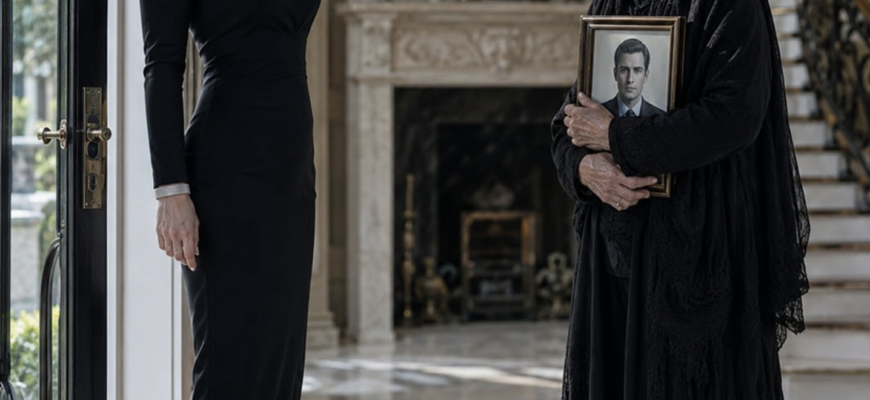
I buttoned my coat, picked up my suitcase, and held a small photo of Oleksandr against my chest—the one I had hidden that morning.
The driver said nothing the entire ride. At 11:51 p.m., he stopped near the old hut and left my bags in the mud.
Inside, the house was freezing, damp, and smelled of mold and smoke. I sat on the floor, unfolded my son’s photo, and traced his face with my thumb.
At 5:27 a.m., while sweeping broken glass, a floorboard beneath my foot gave way.
I knelt, pried it open with a rusty tool—and found a metal box sealed with a child’s blue sticker, the kind Oleksandr used as a boy.
Inside were an envelope stamped by a notary in Lviv, a flash drive, and legal documents.
The first line bore my name: Nadiia Petrivna Kovalenko.
And beneath it: $1,800,000.
My hands started shaking as my phone rang.
“Lawyer Marchuk,” a voice said.
“If you’ve found it, then Kseniia has already lost.”
Outside, a branch snapped.
Fresh footprints marked the wet ground near the porch.
“Do not open the door,” the lawyer warned. “Oleksandr expected this.”
Then came a knock. Three times. Calm. Controlled.
“Mrs. Nadiia,” a man called. “Your daughter-in-law sent me. There’s been a misunderstanding.”
“Take the flash drive,” the lawyer said urgently. “I’m already on my way with the police.”
The knock came again—closer this time.
I slipped the flash drive into my pocket and stepped back from the window. My son’s photo lay on the floor, his expression calm, as if he had foreseen everything.
Twenty minutes later, headlights cut through the dark.
The man outside tried to flee, but police caught him near the fence. In his pocket, they found a message from Kseniia: *“Find the box before the old woman understands.”*
By noon, we were in the notary’s office in Lviv.
Three months before his death, Oleksandr had revised his will. Everything—property, accounts, company shares—was protected by strict legal conditions. Kseniia would receive nothing if she attempted coercion, concealment, or forced removal of me.
And she had done all three.
The flash drive confirmed it all: recordings of her voice, her plans, even her laughter as she spoke about getting rid of me before the documents surfaced.
When Kseniia arrived, still dressed in mourning black, she tried to maintain her composure.
But the room no longer belonged to her.
Marchuk placed the documents in front of her. Her expression broke the moment she saw Oleksandr’s signature.
I didn’t raise my voice. I didn’t need to.
I simply held my son’s photograph and said, “You tried to take his house from me. But he left me something greater than money.”
Justice.
A month later, I returned to the Pechersk house—not as someone to be discarded, but as the mother Oleksandr had protected even after death.